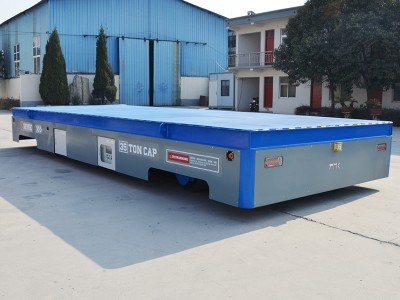
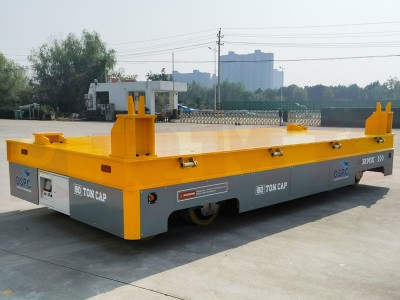
Humanistic Customized
5-Ton Lifting Omnidirectional Transfer Cart for Transformer Transport
Transformer manufacturers regularly move heavy, awkward loads between assembly bays, test stations and storage areas. In principle this is a lifting and transport task. In practice three things decide whether a cart works on the shop floor: whether the load can be supported safely, whether the platform can meet the height of the workstation, and whether the cart can be steered in the space that is actually available.
A customer in Bulgaria selected a REMARKABLE 5-ton lifting omnidirectional transfer cart for this duty. This case study explains the handling requirements behind the choice, how the cart is configured, and the working sequence used to move transformers inside the plant.
- 5-ton rated load with a load deck designed around the transformer footprint and centre of gravity.
- Scissor lifting removes the need for a pit or ramp when the receiving station sits at another height.
- Omnidirectional travel allows sideways positioning in aisles where a conventional cart cannot turn.
At a glanceProject snapshot
| Location | Bulgaria |
| Equipment | Lifting omnidirectional transfer cart |
| Rated load | 5 tons |
| Industry | Power equipment manufacturing / transformer production |
| Payload | Transformers and related equipment |
| Core functions | Load carrying, platform lifting, omnidirectional travel |
| Typical duty | In-plant transfer between assembly, testing and storage areas |
Section 01Why transformer handling is not a simple weight problem
Transformers are heavy, but weight alone rarely decides the specification. Units vary in footprint, the centre of gravity sits high, and the support points are not always symmetrical. A cart is normally required to move between an assembly bay, a test area and a storage position, so the route, the floor and the transfer height all have an influence.
The four requirements below are the ones that most often change the equipment selection.
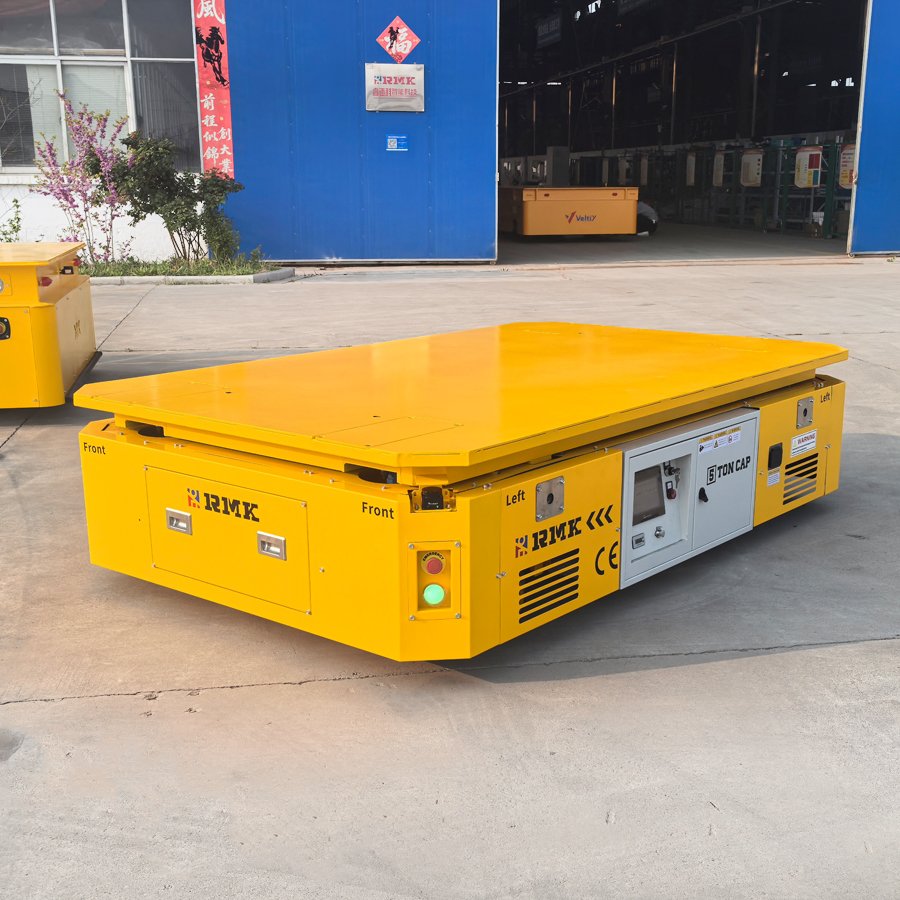
A 5-ton rating means the cart is rated for 5 tons under its defined working conditions. It does not by itself confirm that a particular transformer is within scope: the actual weight, the support points and any eccentric loading still need to be checked against the platform.
Section 02The solution: a 5-ton lifting omnidirectional transfer cart
2.1 Rated load and load distribution
The cart is rated at 5 tons and is intended for transformers and comparable industrial loads within that rating. In practice, the following points are reviewed before the platform is finalised:
- the actual weight of the unit being moved;
- its length, width and height;
- the position of the centre of gravity and any offset loading;
- where the load is supported on the platform;
- floor capacity and the condition of the running surface.
2.2 Lifting platform for height matching
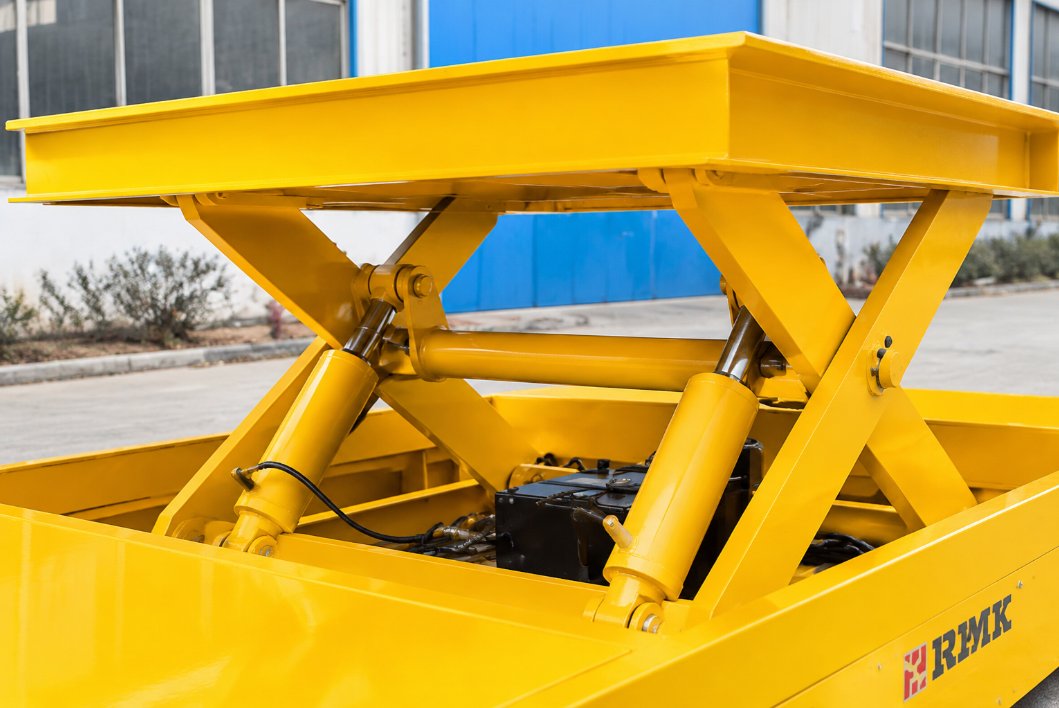
Unlike a flat transfer cart, this unit integrates a scissor lifting mechanism, so the platform can be raised or lowered to suit the loading height and the receiving station. That removes the need to build a pit or a ramp purely to bridge a height difference.
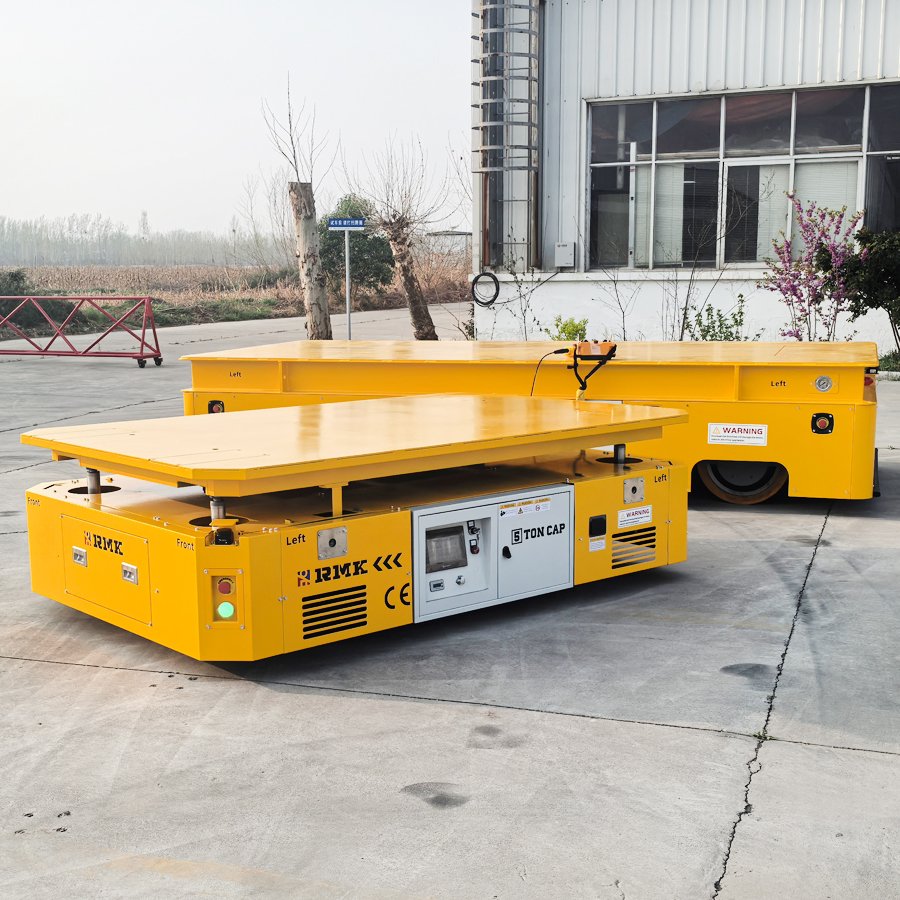
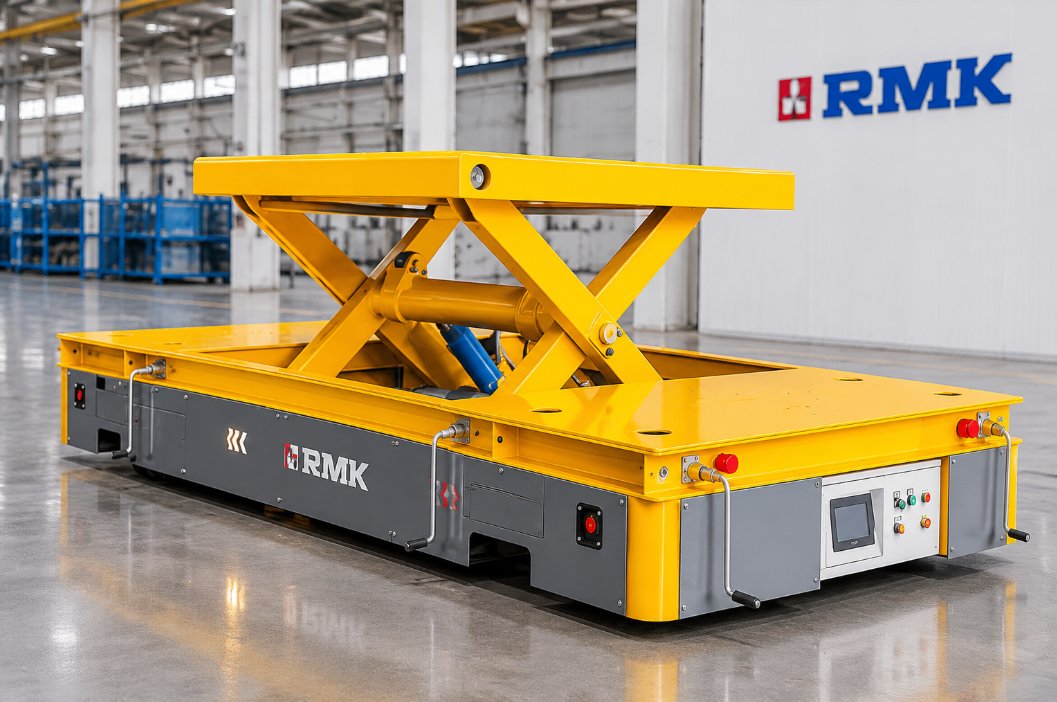
Lifting is normally used for transfer duties that require the load height to be adjusted, docking to equipment or workstations at a different level, loading and unloading where a height change is needed, and process steps that combine horizontal travel with height adjustment.
The usable lift height, lifting speed and permissible load in the raised condition depend on the final configuration of the unit and should be confirmed against the technical data for the delivered cart.
2.3 Omnidirectional travel
The omnidirectional drive is the feature that made this project practical. Where a conventional cart has to shuffle forward and back to reposition, this platform can move sideways as well, which matters when the unit has to be lined up precisely next to a test station.
| Motion mode | Function |
|---|---|
| Forward / reverse | Travel along the longitudinal axis of the cart |
| Sideways left / right | Lateral movement without changing heading |
| Left / right turn | Change of heading under normal steering |
| Rotation in place | Rotation within the conditions permitted for the unit |
Whether the cart can pass a particular aisle is a route question, not a brochure question. Cart outline, turning envelope, load dimensions and fixed obstructions all need to be checked before the layout is signed off.
2.4 Drive, braking and control
The cart is electrically driven, with the following configuration on this project:
| Drive motor | 3.5 kW |
| Wheels | Φ300 mm × 4 |
| Travel speed | 0–15 m/min |
| Braking | Electromagnetic brake |
| Battery | D-250 × 24, maintenance-free |
| Operation | Wired or wireless remote control, per configuration |
2.5 One platform instead of several machines
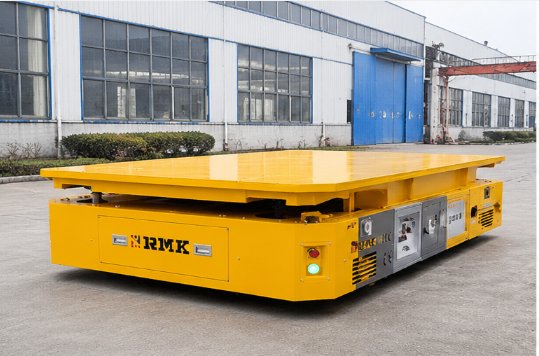
Carrying, lifting and omnidirectional travel are integrated into a single chassis. On a conventional line these three jobs often need a flat cart plus a crane or a lifting table, with the load transferred between them.
Section 03How the cart is used in transformer transport
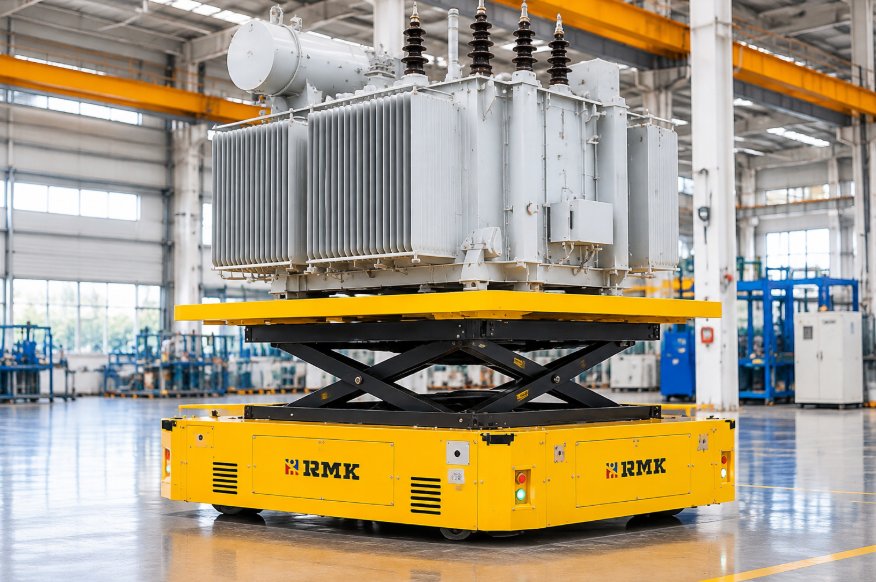
The sequence below summarises how the functions fit together in normal operation. It is a typical sequence derived from the equipment functions, not a reconstruction of every step at the customer's plant.
Section 04What the configuration delivers
| Function | Requirement addressed | Practical value |
|---|---|---|
| 5-ton capacity | Heavy unit transport | Carries loads within the rated condition |
| Platform lifting | Loading and docking at different heights | Height is set by the cart, not by a pit or ramp |
| Omnidirectional travel | Tight aisles and awkward approach angles | Positioning with less turning space |
| Electric drive | In-plant material movement | Consistent traction for repeated trips |
| Integrated design | Horizontal travel plus height adjustment | Fewer handovers between machines |
Measured productivity gains depend on the load, the plant layout, the number of trips and the final configuration. Any efficiency figure quoted for a project should come from that site's operating data, not from a generic assumption.
Section 05Customisation: what can be adapted
Transformer plants differ in layout, route and unit size, so the cart is normally engineered around the duty rather than picked from a catalogue.
| Design area | What can be adapted | Reason |
|---|---|---|
| Load capacity | Load structure for different tonnages | Match the weight of the unit |
| Chassis and deck | Platform size, cart size, structural form | Match the load footprint |
| Travel system | Omnidirectional or other steering options | Match the plant route |
| Lifting mechanism | Lift design to suit the working heights | Match docking requirements |
| Power supply | Battery or other supply suited to distance and shift length | Match working environment |
| Control | Wireless remote, PLC control and similar options | Match operating requirement |
| Safety | Braking, audible and visual alarms, anti-collision | Match site safety rules |
Related equipment used for similar duties includes customised trackless transfer carts, steering-wheel omnidirectional transfer carts and automated rail transfer trolleys. The right form depends on the load parameters, the route and the site conditions.
Selecting a cart means looking at the load, the centre of gravity, the support method, the working height, the route and the floor — not just the tonnage.
To assess a project quickly, send us:
- weight and external dimensions of the load;
- support points underneath the load and its centre of gravity;
- required lifting height;
- route through the plant and the narrowest aisle;
- floor condition and operating environment;
- daily running time and expected trip frequency.
Note: the working sequence in this article describes how the equipment functions are applied in typical transformer handling. It is not a step-by-step reconstruction of the customer's site operations. Actual operation must follow the equipment manual and the site safety procedures.
Send the load weight, footprint and required lift height — we will come back with a configuration.
Get a proposal