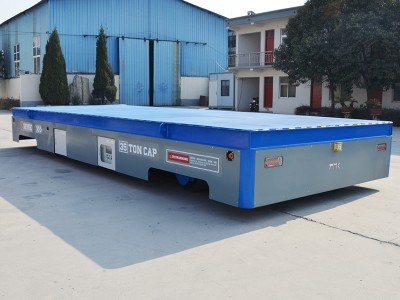
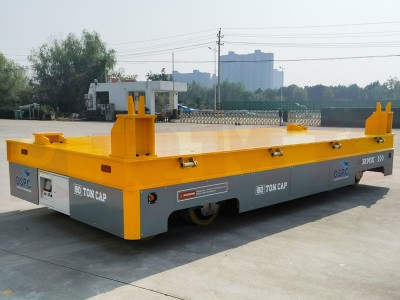
Humanistic Customized
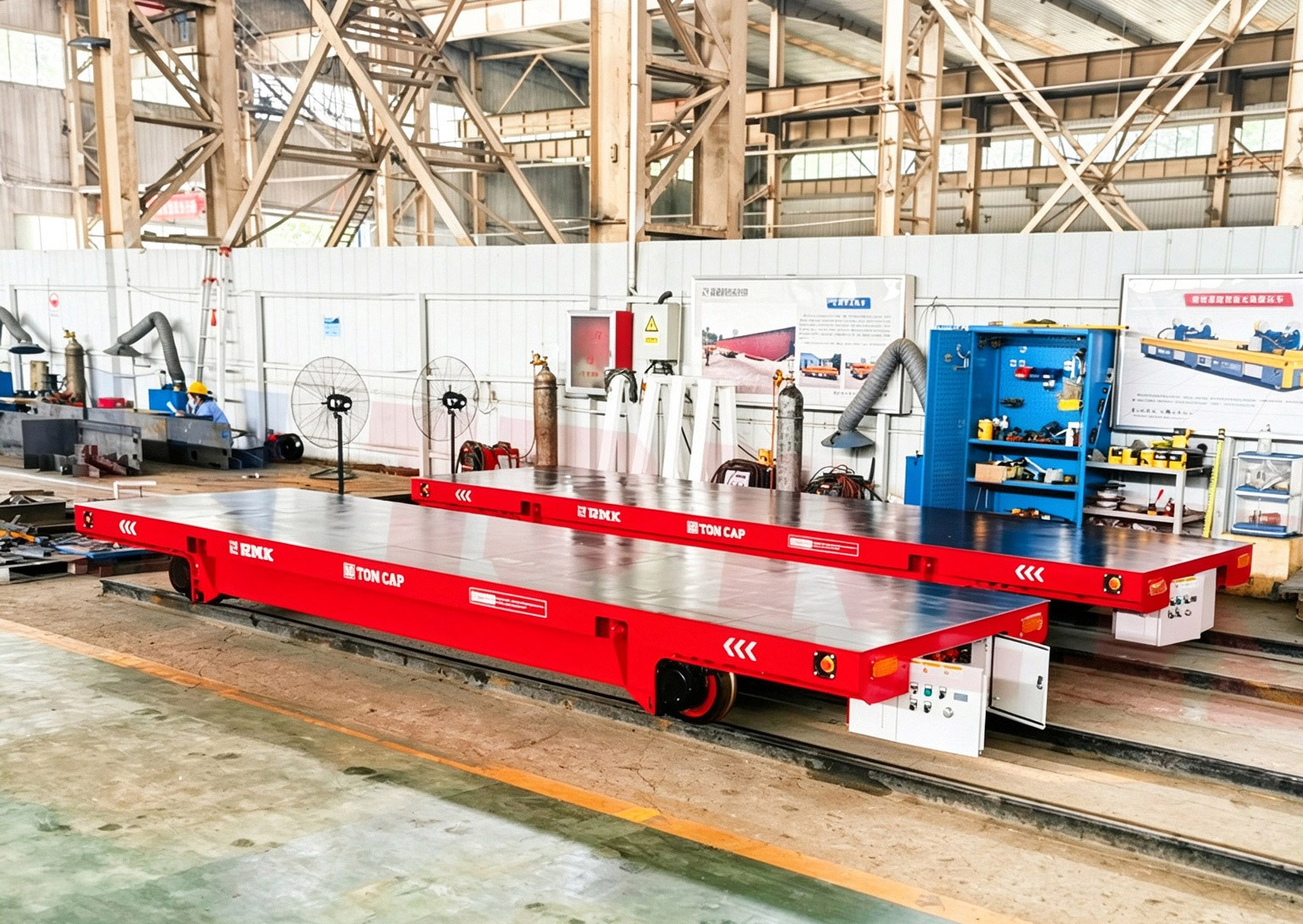
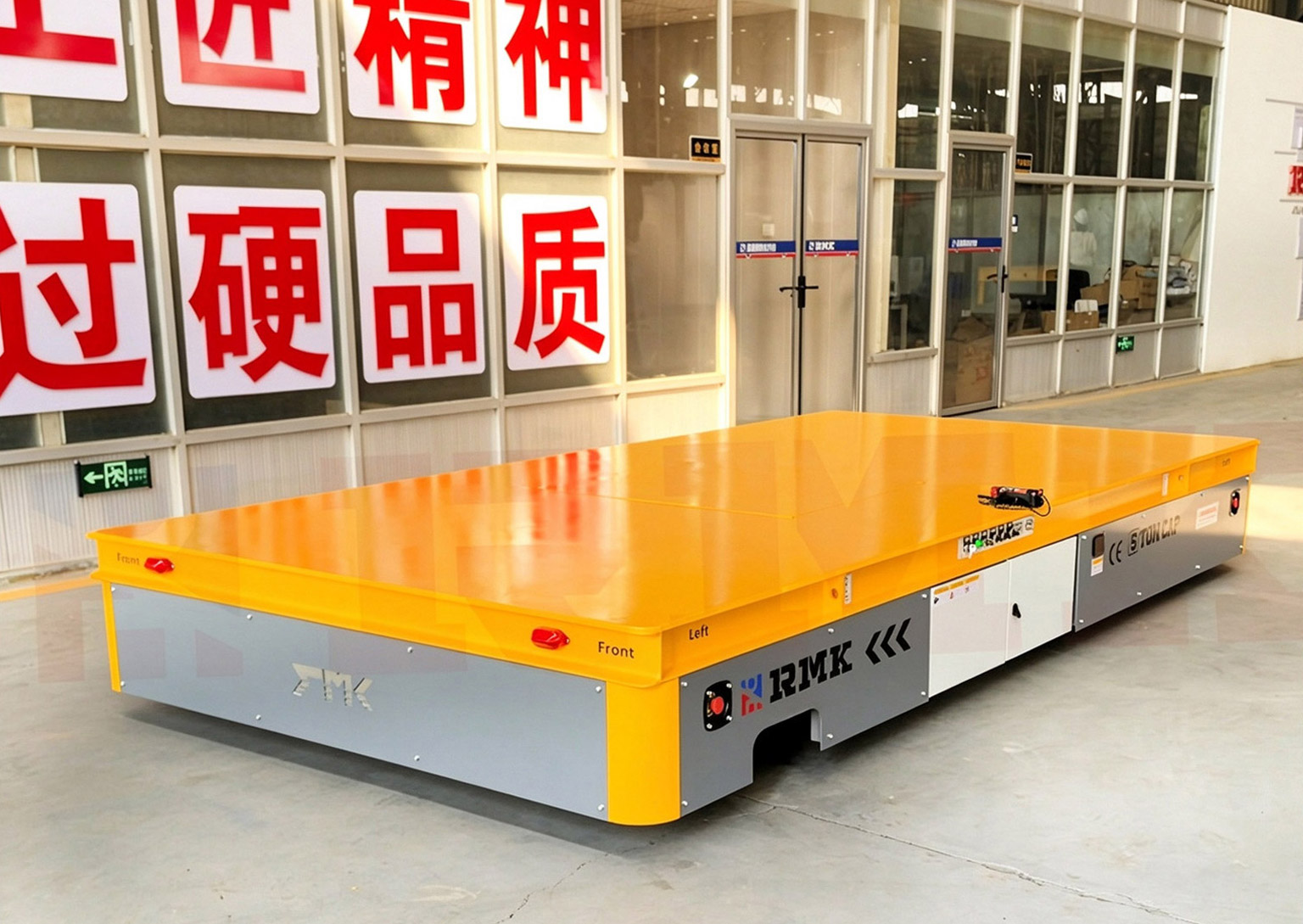
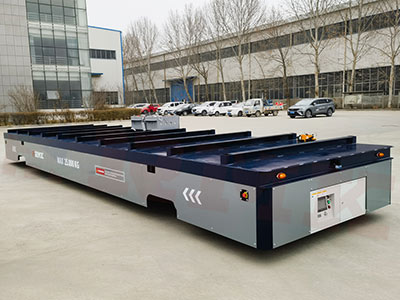
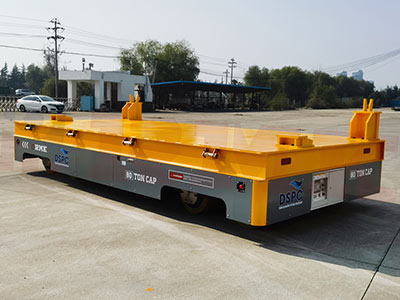
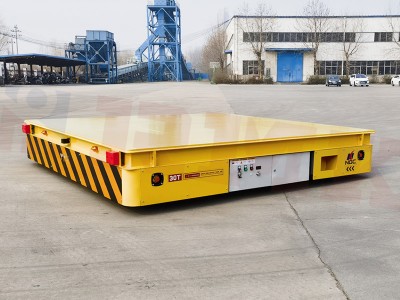
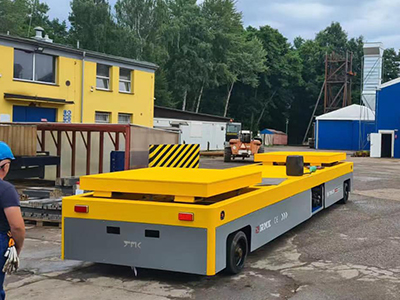
Control method: Wireless remote control
Key Differences Between Rail-Guided and Trackless Transfer Carts
| Comparison Criteria | Rail-Guided Transfer Cart | Trackless Transfer Cart |
| Operating Method | Travels along fixed tracks | Travels directly on the factory floor |
| Route Characteristics | Follows a predefined, fixed route | Can follow different routes depending on the operating area and steering capabilities |
| Site Requirements | Requires assessment of track installation conditions and foundation requirements | Requires assessment of floor load-bearing capacity and operating conditions |
| Route Flexibility | Restricted by the track layout | Offers greater route flexibility |
| Steering Method | Guided by the track layout | Controlled by the vehicle's steering system |
| Power Supply | Multiple power supply options are available | REMARKABLE's trackless models use battery power |
| Typical Applications | Fixed routes and repetitive transportation tasks | Transportation between multiple workstations and applications requiring flexible routing |
It is important to note that the power supply method does not determine whether a transfer cart is rail-guided or trackless.
What Is a Rail-Guided Transfer Cart?
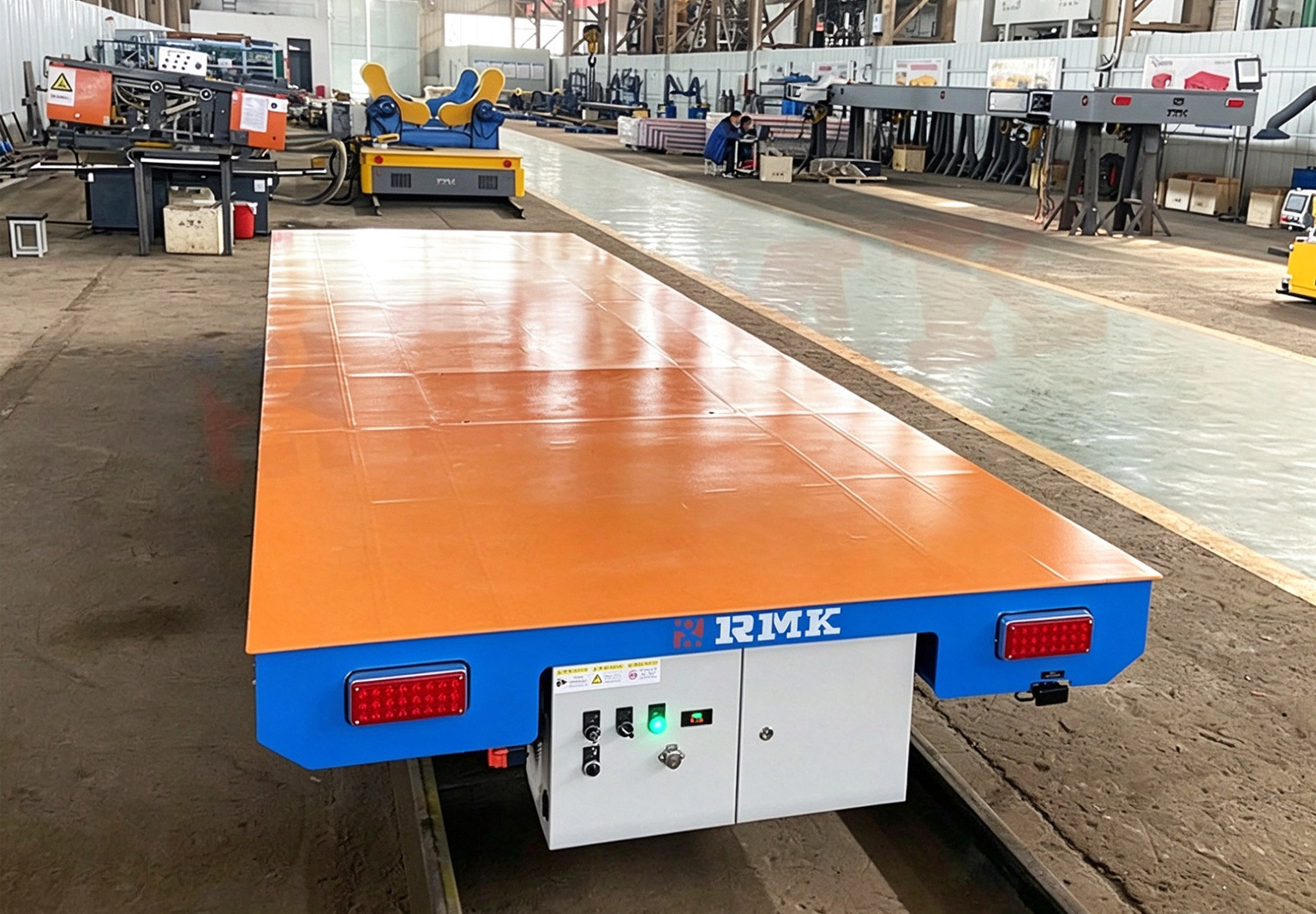
How Does a Rail-Guided Transfer Cart Work?
- Overhead crane or other suitable lifting equipment places the material onto the transfer cart's load platform.
- The operator starts and controls the vehicle using a wired pendant, wireless remote controller, or automatic control system.
- The drive system propels the vehicle along the installed tracks.
- The transfer cart stops at the designated position, where the material is unloaded.
- The empty vehicle returns to its starting point or proceeds to the next transportation task.
Main Advantages of Rail-Guided Transfer Carts
- Stable Guidance Along Fixed Routes
The tracks define the vehicle's travel path, eliminating the need for active steering adjustments during normal operation. When materials need to be transported repeatedly between the same workstations, this arrangement helps establish a stable and consistent transportation process. - Suitable for Heavy-Duty Transportation
Rail-guided transfer carts can be engineered for heavy-duty applications based on specific load requirements and operating conditions. They are suitable for transporting steel, transformers, large equipment, and other heavy workpieces. - Ideal for Repetitive Transportation Tasks
In production facilities with fixed transportation routes and predictable material flows, rail-guided transfer carts can be integrated into production processes to create a more consistent material handling workflow. - Multiple Power Supply Options
Rail-guided transfer carts are not restricted to a single power supply method. Depending on project requirements, they can be configured with battery power, cable reel power supply systems, low-voltage rail power supply systems, or conductor bar power supply systems.
What Should You Consider When Selecting a Rail-Guided Transfer Cart?
- Whether the transportation routes will remain fixed over the long term.
- Whether the floor structure can accommodate the required track foundations and installation arrangements.
- Whether the track layout can meet the requirements for vehicle turning and material transfer.
- Whether track installation will interfere with existing production activities.
- Whether track modifications may be required if the factory layout changes in the future.
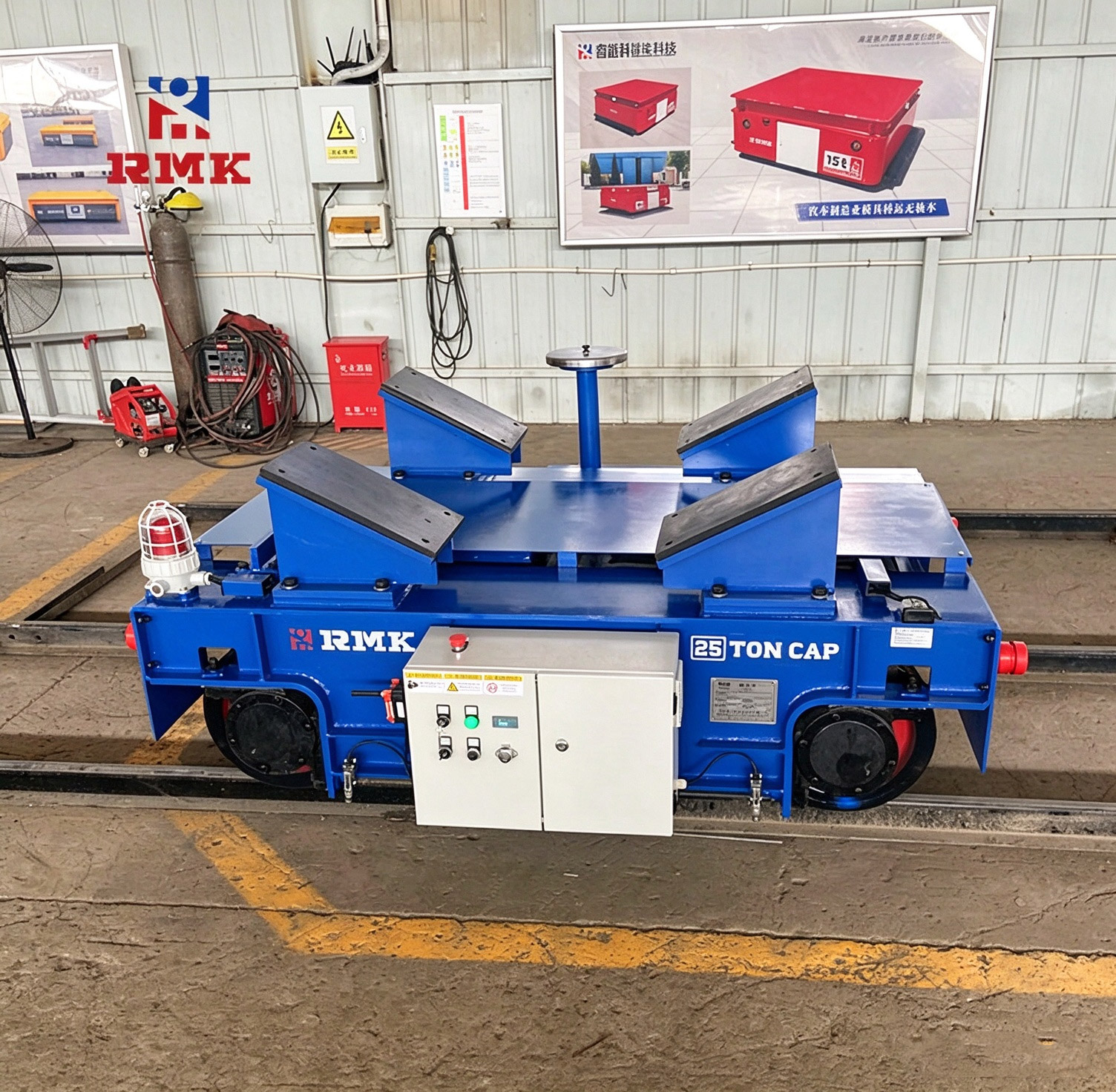
For industrial environments with potential explosion hazards, rail-guided transfer carts can be specially designed and configured according to the hazardous area classification and applicable equipment requirements.
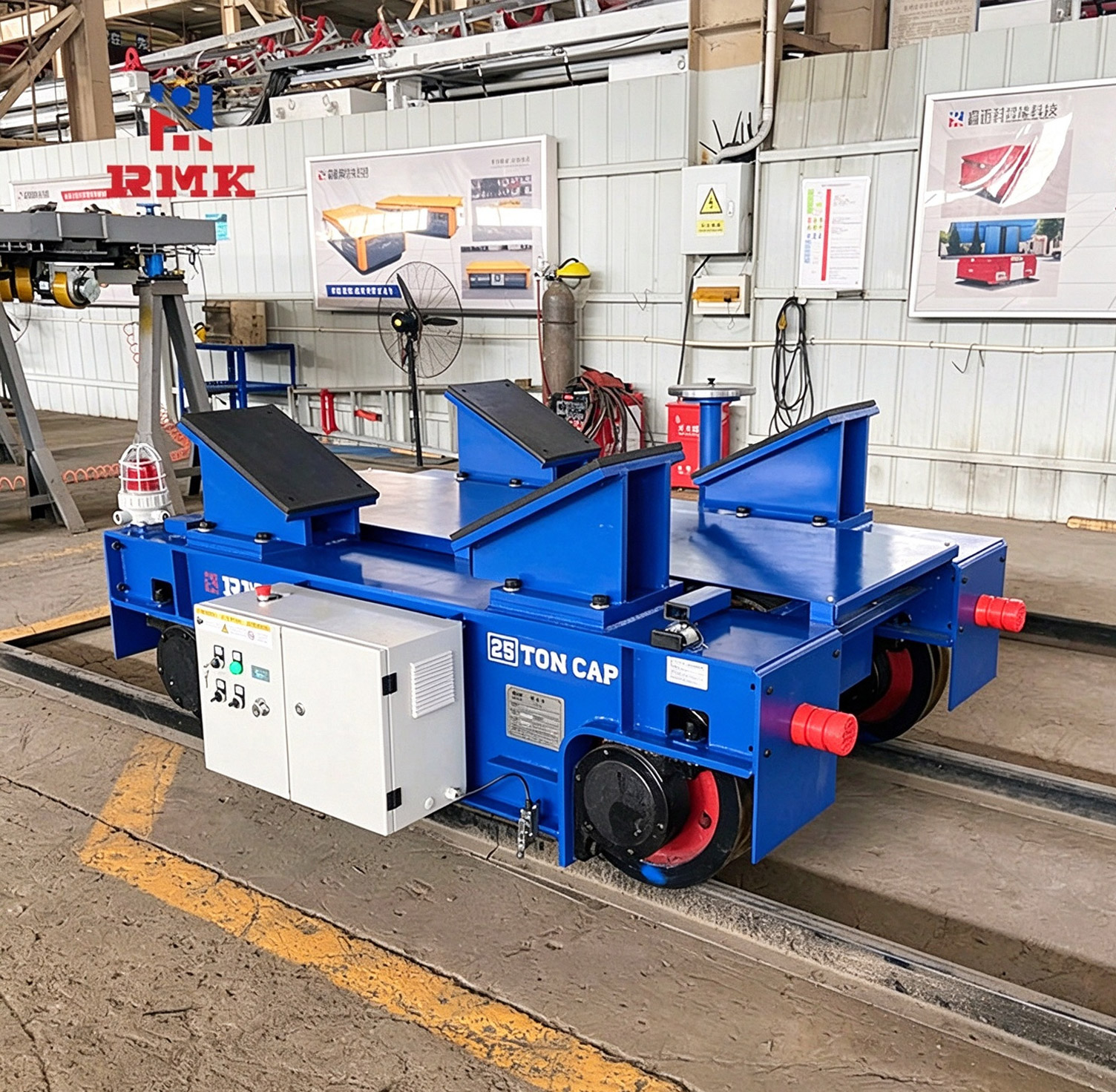
When transportation routes are stable, repetitive, and suitable for permanent track installation, rail-guided transfer carts are generally a solution worth considering.
What Is a Trackless Transfer Cart?
It uses wheels, a drive system, and a steering mechanism to transport materials between different workstations. Depending on its design, it can move forward, backward, and turn, as well as perform lateral movement, diagonal travel, or in-place rotation.
Trackless transfer carts are commonly used in equipment manufacturing, mold handling, automotive production, warehouse logistics, and large equipment assembly. They are particularly suitable for factories where transportation routes are not restricted to a single fixed path.
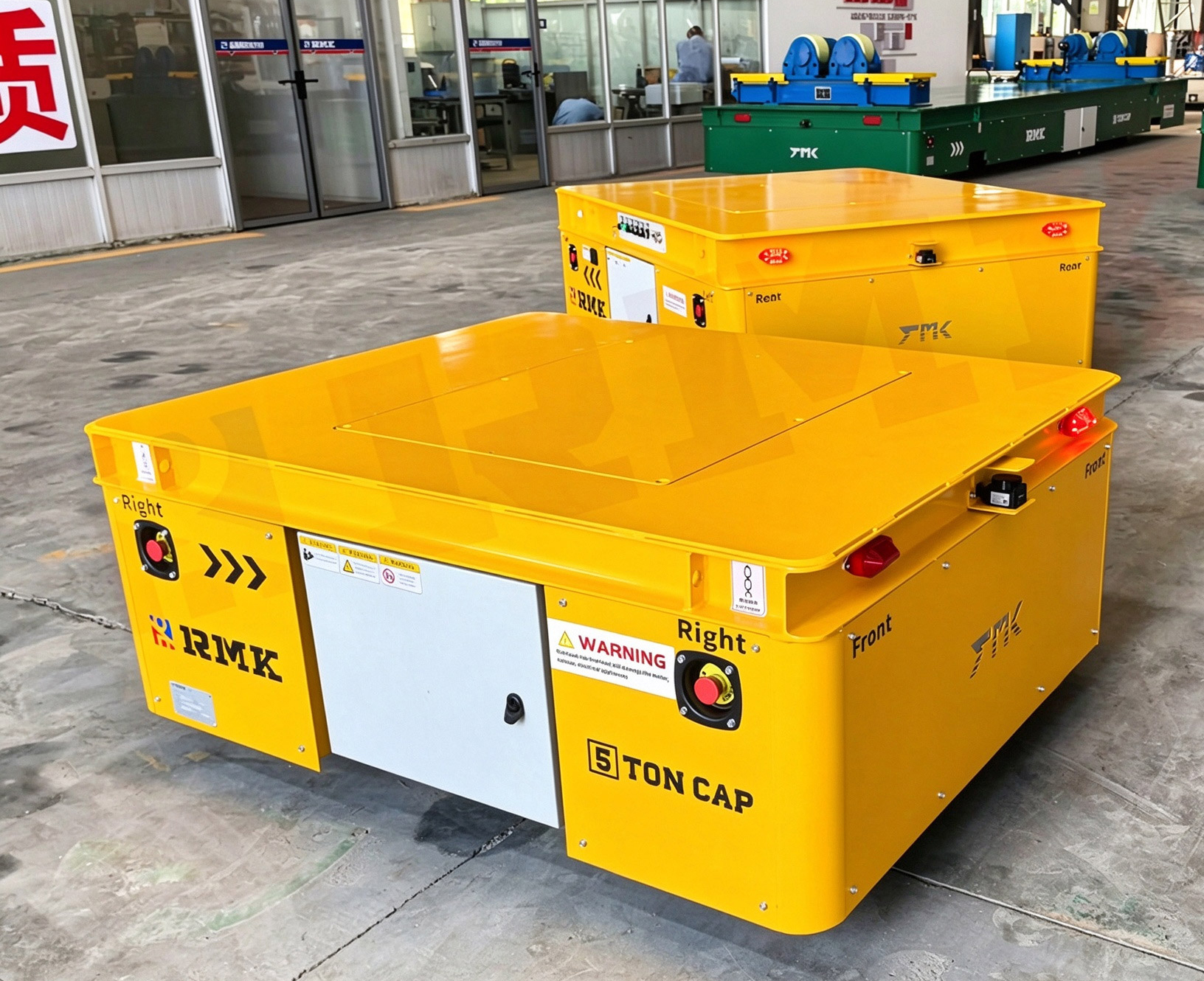
Control method: Wireless remote control
Steering method: Differential steering
How Does a Trackless Transfer Cart Work?
- The operator starts and controls the vehicle using a wired pendant, wireless remote controller, or automatic control system.
- The drive and steering systems move the vehicle along the designated travel route.
- The vehicle adjusts its direction according to the destination and operating requirements.
- The vehicle stops at the designated position for unloading or the next operation.
Omnidirectional transfer carts can also be designed to perform lateral movement, diagonal travel, and 360-degree in-place rotation, depending on their wheel configuration and control system. These capabilities make them suitable for production areas with limited space or complex transportation routes.
Steering Configurations of Trackless Transfer Carts
- Differential Steering
The vehicle turns by adjusting the speed difference between the left and right drive wheels. This configuration has a relatively simple structure and is suitable for applications with comparatively straightforward travel routes. - Hydraulic Steering
Hydraulic steering uses a hydraulic system to actuate the steering mechanism. It can be configured for heavy-duty transfer carts that require substantial steering force, depending on the vehicle design and load requirements. - Omnidirectional Steering
Omnidirectional transfer carts use specialized wheel arrangements and steering or drive mechanisms to achieve movement in multiple directions. Depending on the specific configuration, they can move longitudinally, laterally, and diagonally, as well as rotate 360 degrees in place.
These capabilities make them suitable for production areas with limited space and complex transportation routes.
Main Advantages of Trackless Transfer Carts
- Greater Route Flexibility
Without fixed rails, trackless transfer carts can serve multiple workstations within their permitted operating areas. Their travel routes can also be adjusted to accommodate changes in production layouts.
Factories with frequently changing production processes or a need to transport large materials between multiple areas can particularly benefit from this flexibility. - No Permanent Rail Installation Required
Trackless transfer carts do not require permanently installed steel rails, which can reduce the civil engineering work associated with rail installation.
However, this does not mean that no site preparation is required. The factory floor must still meet the vehicle's operating requirements under the intended load conditions. - Suitable for Transportation Between Multiple Workstations
When floor layouts, traffic conditions, and operating requirements permit, a single trackless transfer cart can serve multiple production areas. This reduces the limitations associated with fixed transportation routes.
What Should You Consider When Selecting a Trackless Transfer Cart?
Before selecting a trackless transfer cart, check the following conditions:
- Floor load-bearing capacity.
- Floor flatness and surface conditions.
- Floor joints, gaps, and uneven areas.
- Available turning space.
- Floor gradients and transitions between different floor surfaces.
- Traffic conditions involving pedestrians and other vehicles.
Application Example
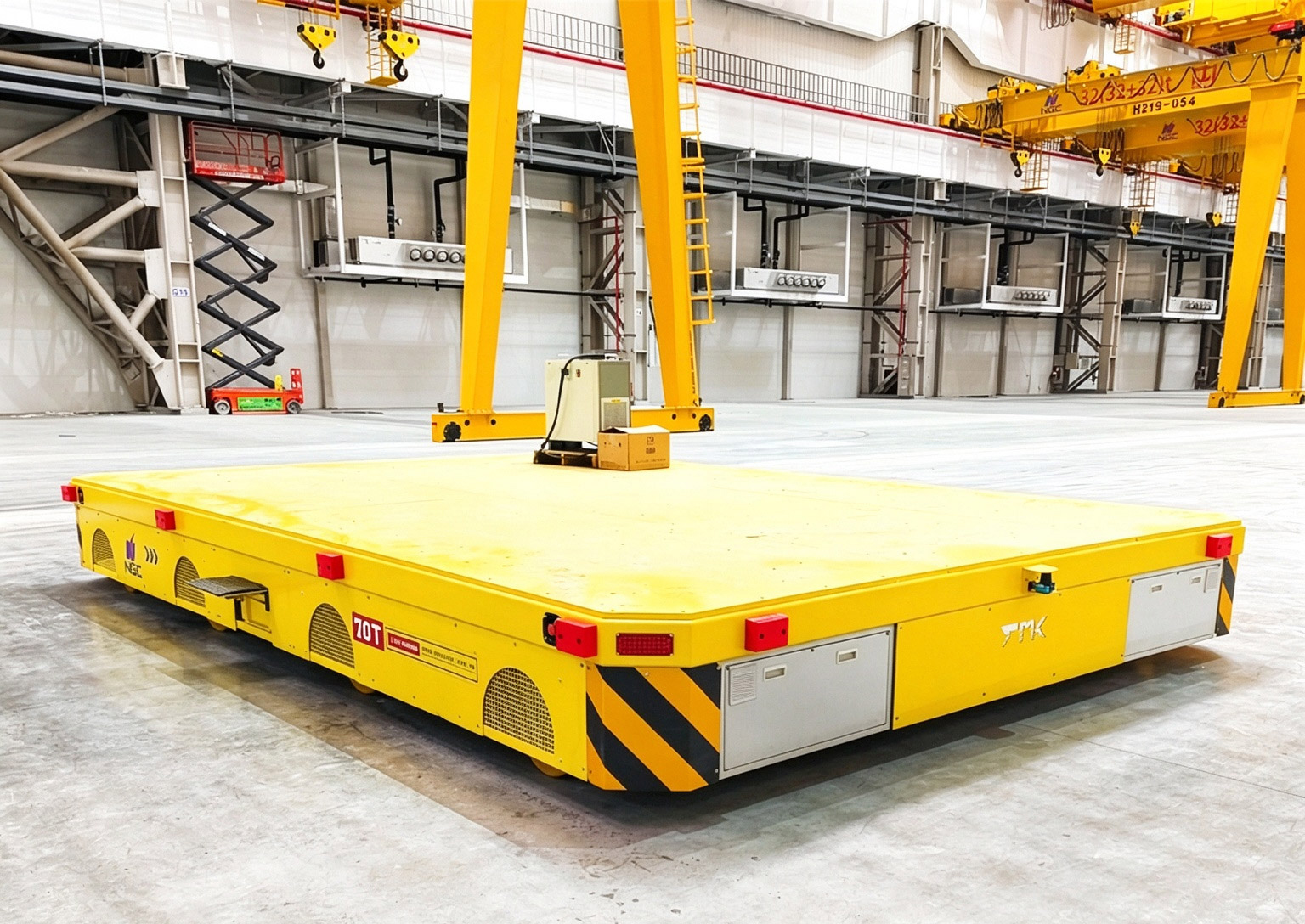
This type of equipment is designed to achieve multidirectional movement through an appropriate wheel arrangement and control system. It is suitable for transporting large workpieces and handling heavy materials in space-constrained areas.
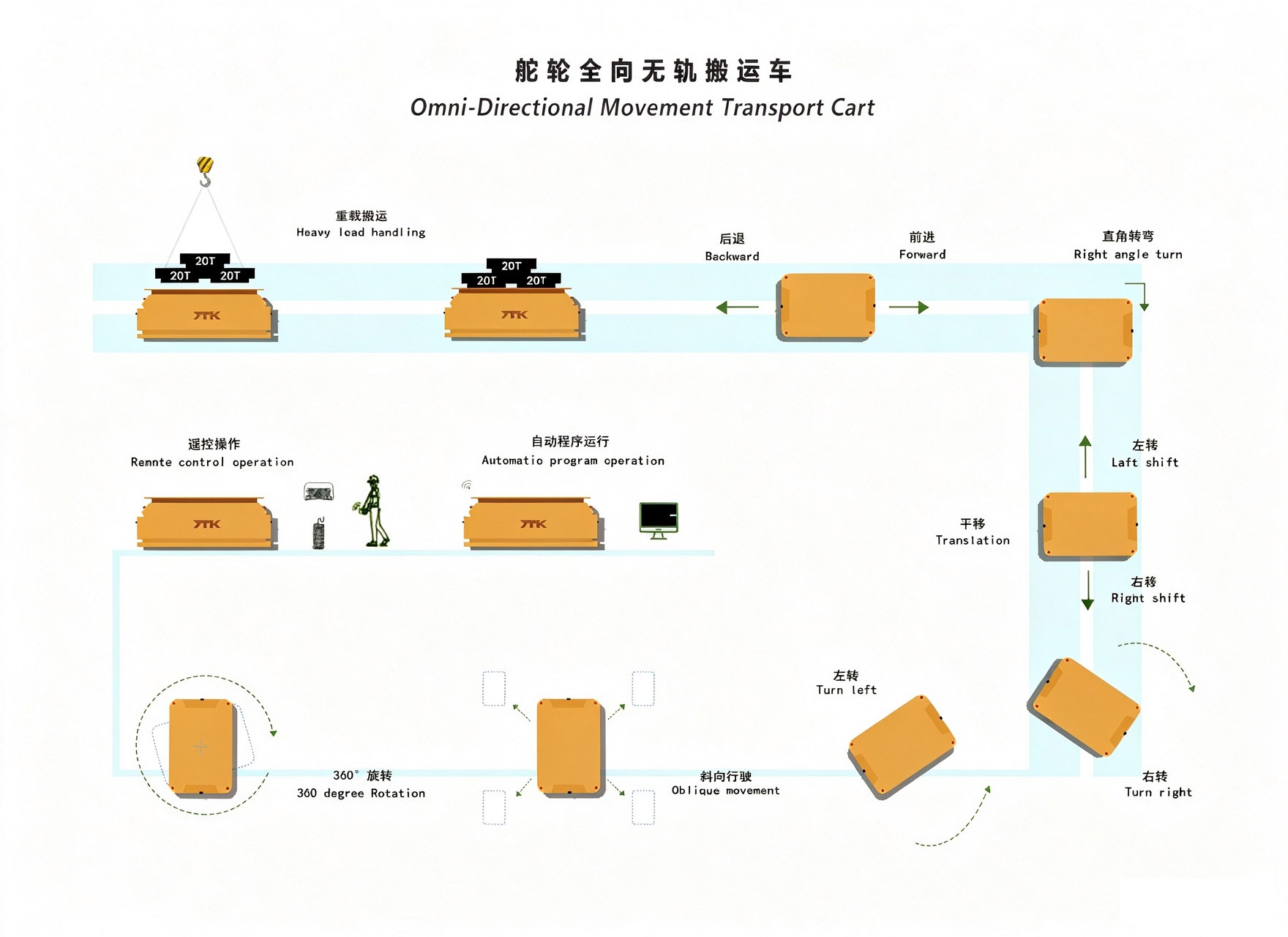
Omnidirectional Trackless Transfer Cart in Operation
The specific configuration of each project must be evaluated according to workpiece weight, dimensions, floor load-bearing capacity, and transportation routes.
How to Choose Between a Rail-Guided and a Trackless Transfer Cart
Select Equipment Based on Actual Factory Operating Conditions
| Equipment Type | Typical Applications | Additional Considerations |
| Rail-Guided Transfer Cart | 1. Transportation between two or a few fixed locations. 2. Frequent daily trips along routes that are expected to remain unchanged over the long term. 3. Heavy-load transportation with schedules closely integrated into production processes. 4. Long-distance transportation requiring extended periods of continuous operation. 5. Factory floors that can accommodate track foundations, with no major changes to the production layout expected in the near future. |
The more closely these conditions match the actual operating requirements, the more suitable a rail-guided solution may be. Final selection should also take into account track installation conditions, power supply requirements, and overall project costs. |
| Trackless Transfer Cart | 1. Transportation between multiple workstations along routes that are not permanently fixed. 2. Production layouts that may change and require flexible route adjustments. 3. Narrow aisles and frequent turns that may require in-place rotation, lateral movement, or diagonal travel. 4. Workshops where floor cutting and civil engineering work for track installation are impractical. 5. Applications where one vehicle needs to serve multiple production areas. |
If lateral movement, diagonal travel, or in-place rotation is required, confirm that the vehicle's wheel configuration and control system support the corresponding movement capabilities. |
How Should You Compare the Purchasing Costs of Rail-Guided and Trackless Transfer Carts?
| Cost Comparison | Rail-Guided Transfer Cart | Trackless Transfer Cart | Additional Considerations |
| Main Cost Components | Equipment purchase cost; Track and foundation installation costs; Power supply system installation costs; Routine track maintenance costs; Future route modification costs. |
Equipment purchase cost; Wheel and steering system maintenance costs; Battery and charging infrastructure costs, where applicable; Necessary floor modification costs; Periodic battery replacement and mechanical component maintenance costs. |
Do not compare equipment purchase prices alone. A comprehensive total cost of ownership assessment is necessary. |
| Key Cost Factors | Can offer cost advantages for fixed routes and long-term, high-frequency operation. However, subsequent track modifications or route changes may involve additional costs. | Offers greater route flexibility and eliminates the need for track-related civil engineering work. However, battery replacement and floor reinforcement may increase operating or initial investment costs. | Ask suppliers to provide a complete solution comparison based on actual site conditions, rather than comparing equipment prices alone. |
How Should Different Industries Choose Between Rail-Guided and Trackless Transfer Carts?
Even within the same factory, both rail-guided and trackless transfer carts may be used for different transportation tasks.
Steel and Metallurgical Industries: Combining Both Solutions Within One Factory
1. Long-Distance Transportation Within the Plant (Main Access Routes and Finished Product Storage Areas)
For fixed routes involving long-distance transportation and high operating frequency, low-voltage rail-powered transfer carts may be a suitable option.
2. Cold Rolling Workshops
For narrow aisles, frequent turns, and routes that may change according to production requirements, battery-powered trackless transfer carts may offer greater flexibility. Depending on their steering and wheel configurations, these vehicles can support 360-degree in-place rotation and can be equipped with customized support structures for steel coil transportation.
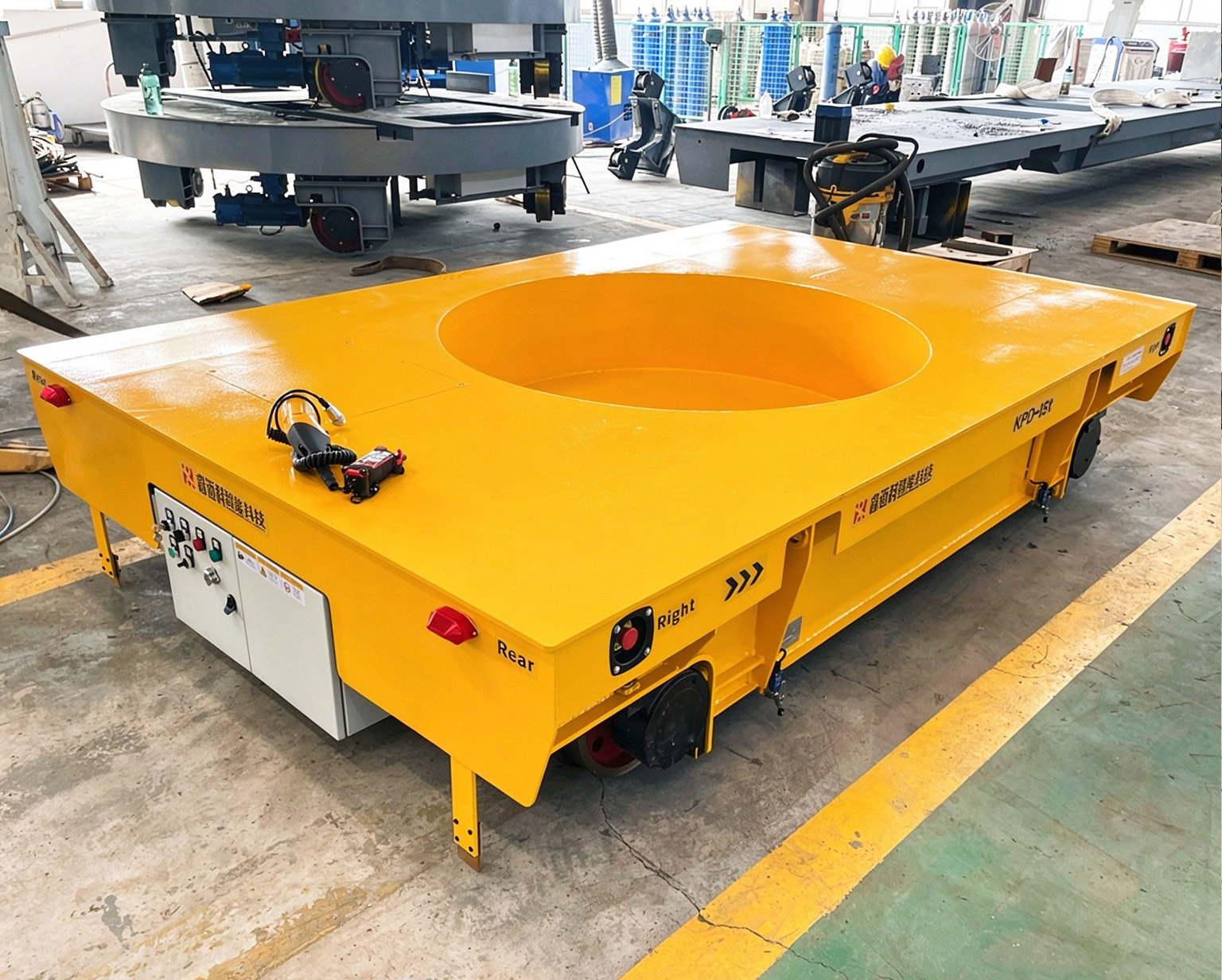
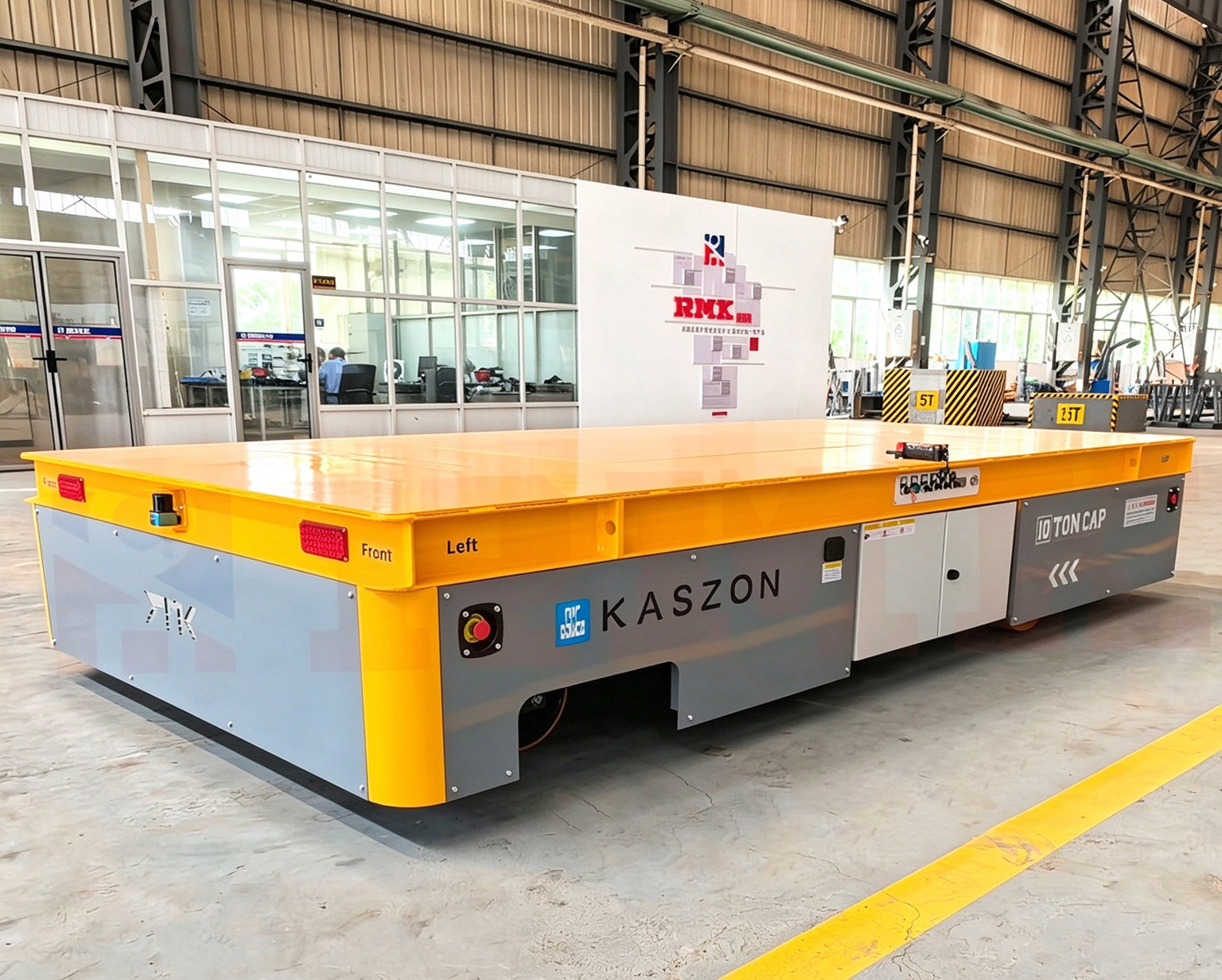
Transportation in hot-rolling areas involves additional challenges, including high-temperature radiation, metal dust, and continuous heavy-duty operation. Transfer carts used in these environments must be specifically designed to withstand the actual operating conditions.
Using both types of transfer carts within the same factory is not about deciding which one is better overall. Instead, equipment selection should follow the principles discussed in Section 4 and take into account the transportation requirements of each operating area.
Automotive Manufacturing: Mold and Large Workpiece Handling
1. Fixed Transportation Routes
If molds need to be transported between a mold storage area and a stamping workshop along a fixed route, a rail-guided transfer cart may be a suitable solution.
2. Transportation Between Multiple Workstations
If molds need to be moved between multiple workstations or production areas, a trackless transfer cart may provide greater route flexibility.
During the design stage, confirm the load platform dimensions, mold support points, positioning requirements, and loading and unloading methods.
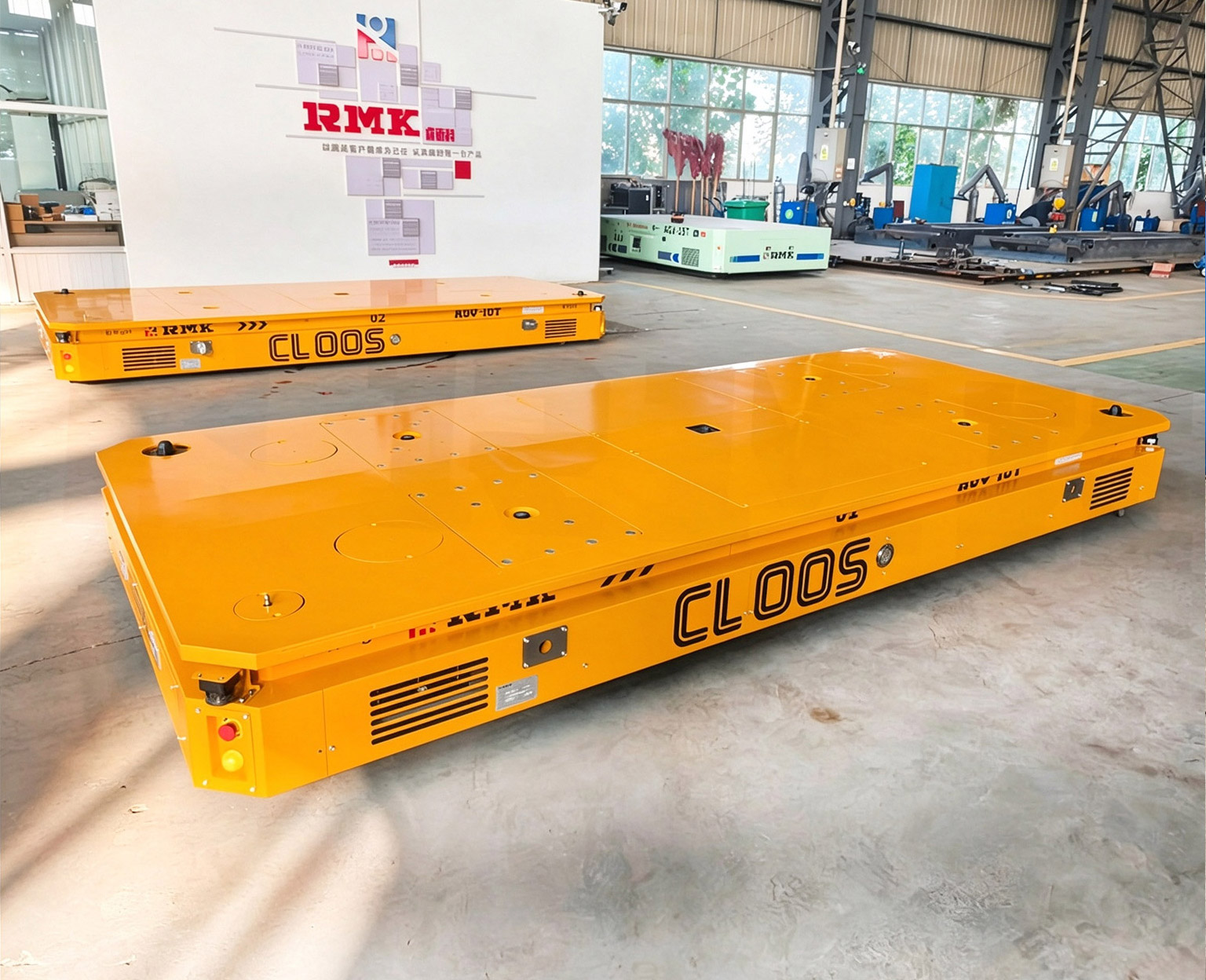
Low-Profile Lifting AGV for Automotive Production Lines
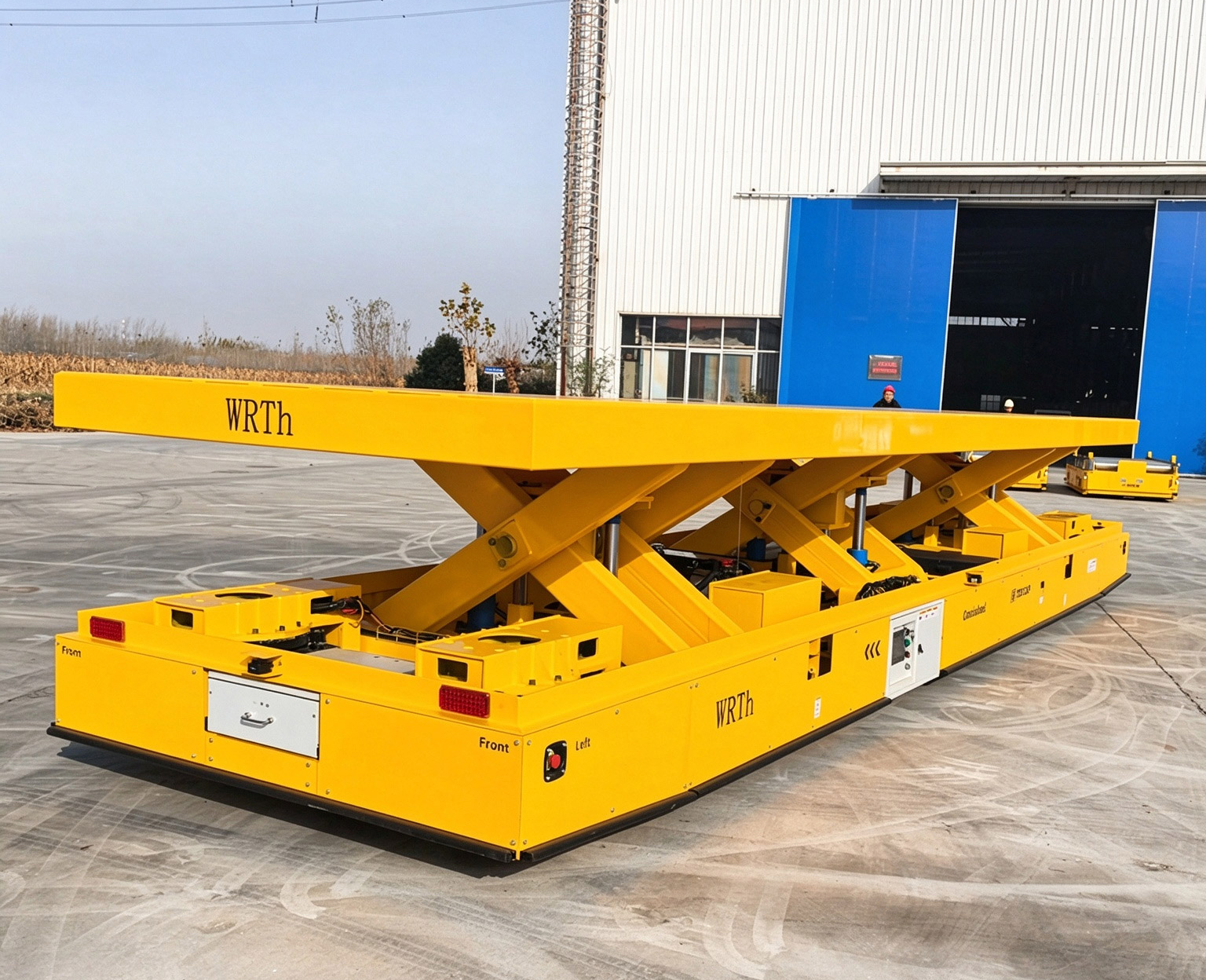
16-Ton Omnidirectional Transfer Cart with Three Synchronized Scissor Lifts
Transformer Manufacturing: Fixed Production Lines and Flexible In-Plant Transportation
The transportation solution must account for workpiece dimensions, center of gravity, travel distance, and the connections between different production workstations.
1. Fixed Production Routes: Rail-Guided RGV Solutions
For fixed transportation routes in large transformer factories, such as those connecting core assembly, coil production, final assembly, testing, and warehousing areas, rail-guided RGV systems can be considered.
These systems are suitable for applications with clearly defined transportation routes and relatively stable production processes.
2. Flexible In-Plant Transportation: Heavy-Duty Trackless Electric Transfer Carts
For flexible material handling within transformer factories, transportation between workshops, and material transfer between storage and loading or unloading areas, heavy-duty trackless electric transfer carts may be suitable.
These vehicles do not require permanently installed tracks and can be configured to operate along designated routes according to factory floor conditions and transportation requirements.
3. Automated Production Lines: AGV Transfer Carts
For automated assembly workstations and intelligent warehouse transportation, AGV solutions can also be considered according to the required level of automation and production system integration.
In addition to the choice between rail-guided and trackless operation, the required level of automation is another important factor in selecting industrial material handling equipment.
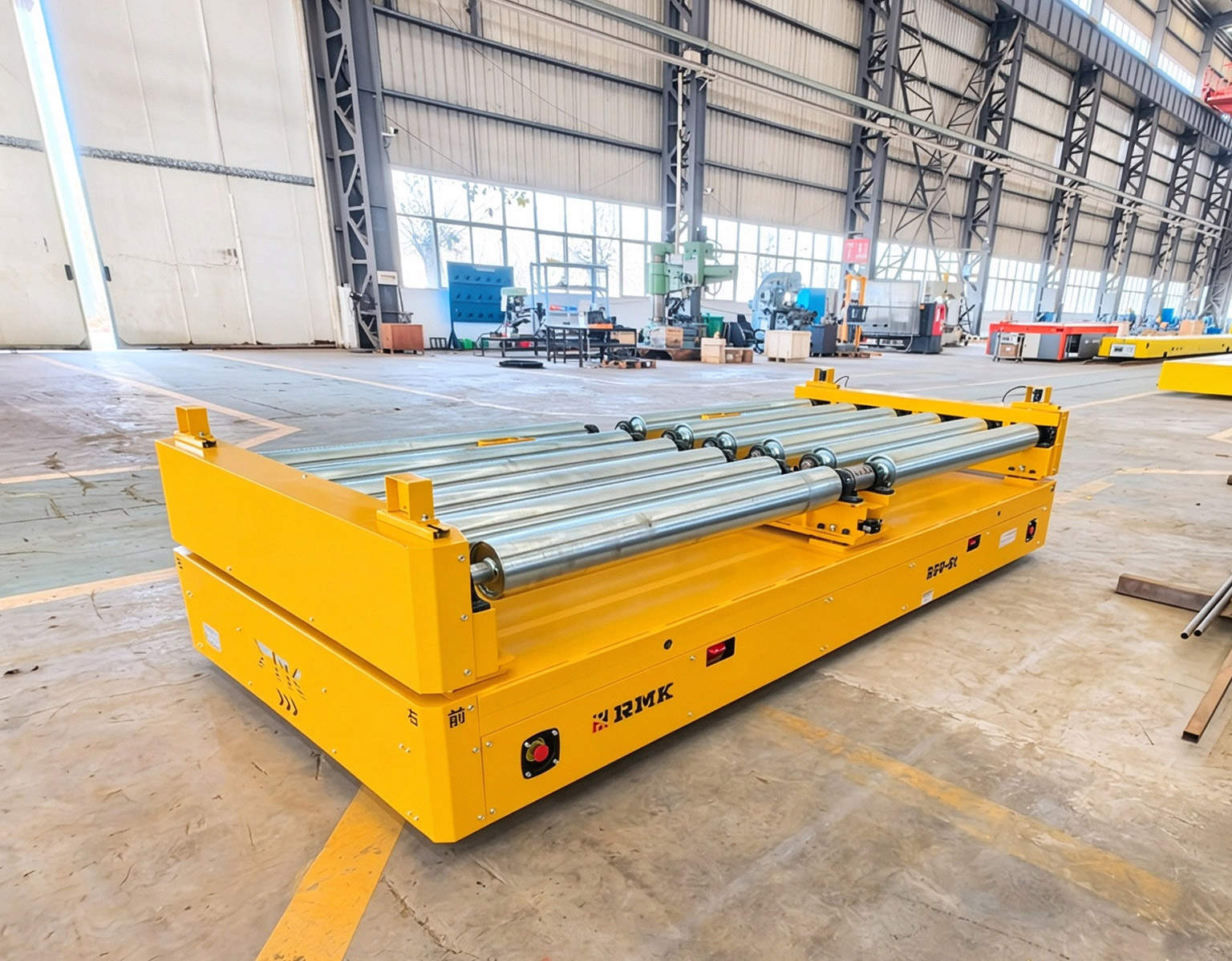
5-Ton Laser-Guided AGV with Customized Roller Conveyor Line
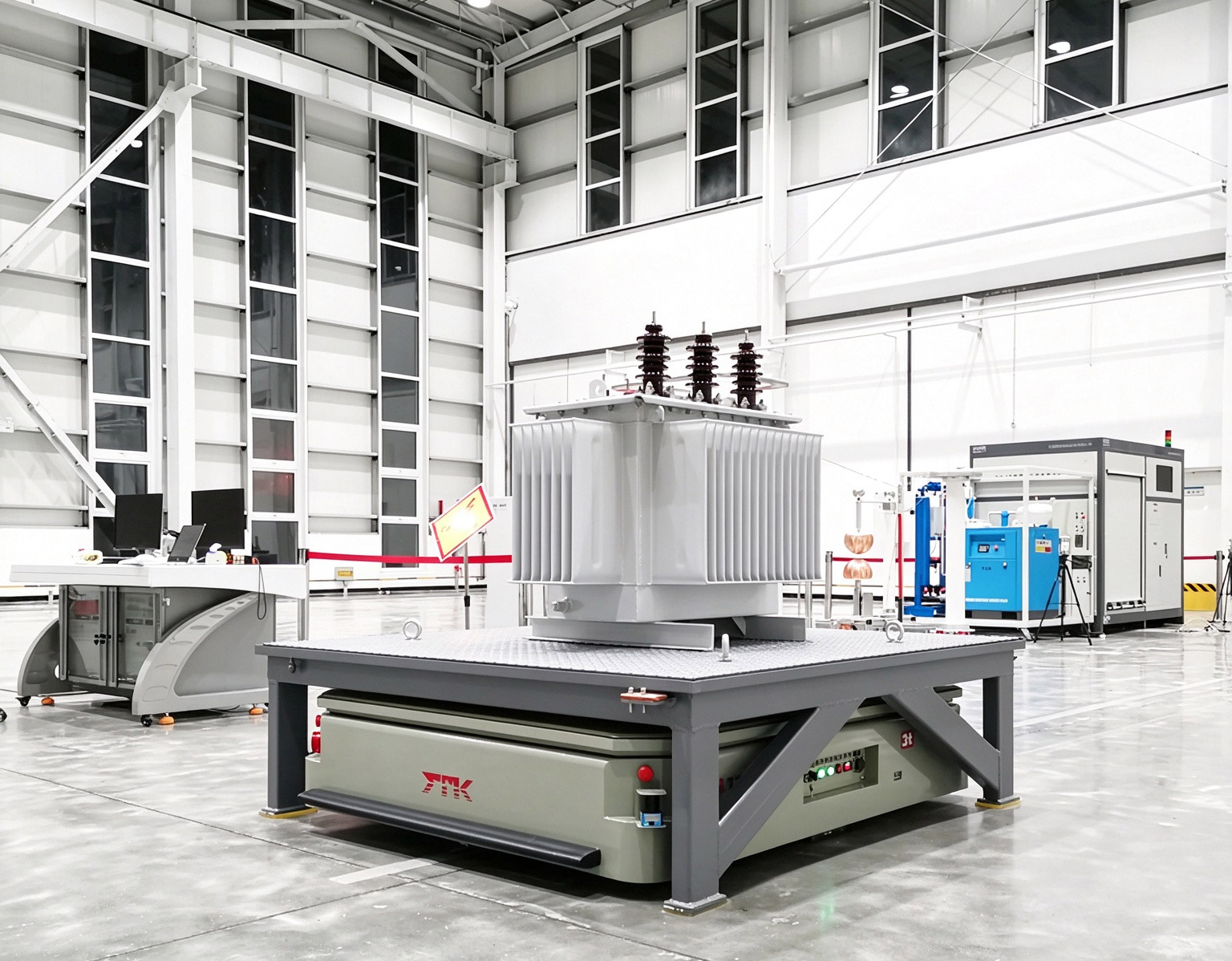
3-Ton Lifting AGV Transfer Cart for State Grid Projects
40-Ton Omnidirectional Hydraulic Suspension Transfer Cart for Transformers
Wind Power Equipment Manufacturing: Large Components and Transportation in Complex Spaces
When transporting tower sections, nacelles, main shafts, and other large components within workshops, the following factors should be considered:
- Workpiece weight and center of gravity;
- Load platform dimensions and support structures;
- Available turning space;
- Workshop floor load-bearing capacity;
- Coordination between lifting equipment and the transfer cart during loading and unloading.
Where operating space is limited, an omnidirectional steering or movement configuration can also be considered, depending on the vehicle's design and the required movement capabilities.
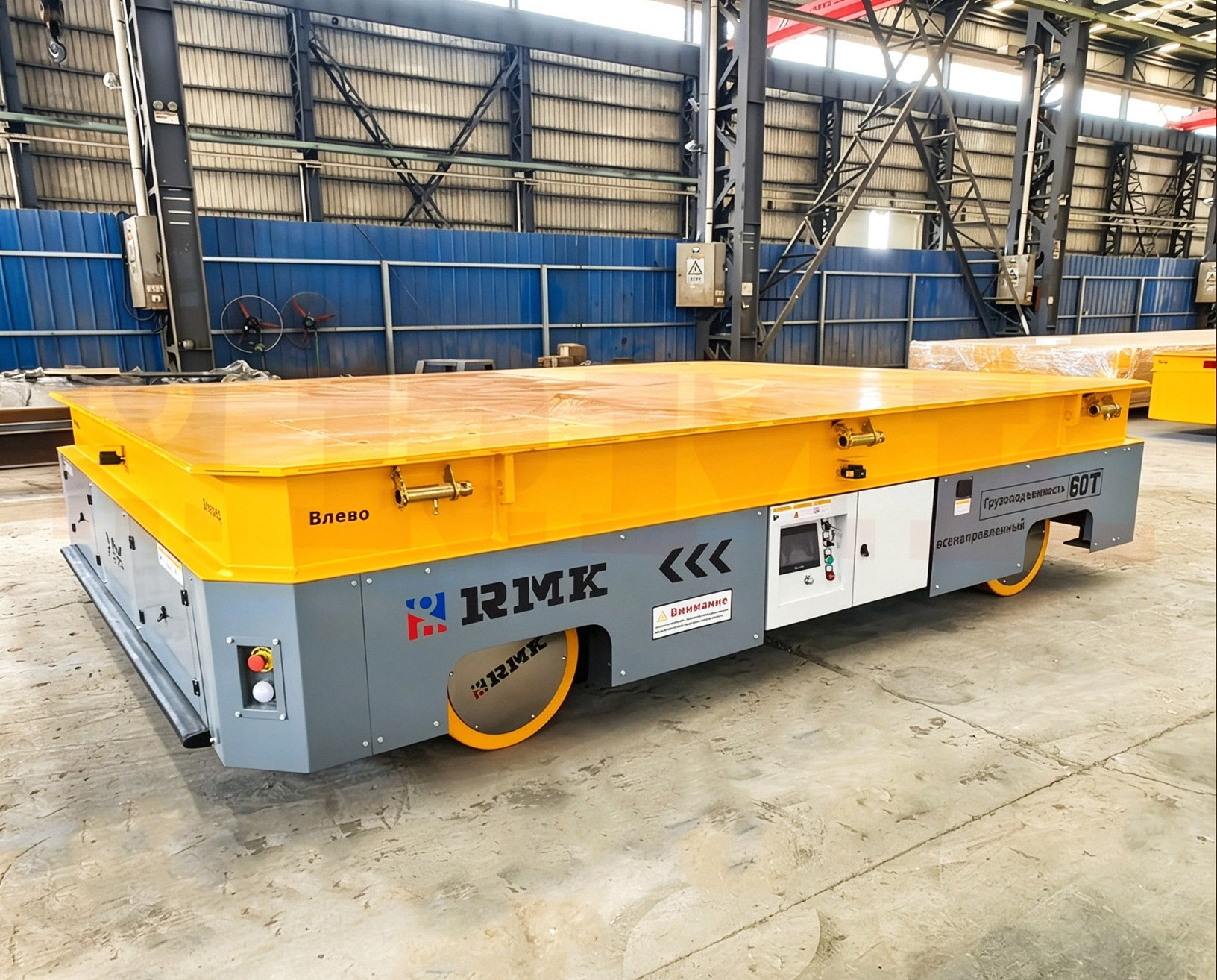
60-Ton Omnidirectional Trackless Transfer Cart with Steering Drive Wheels
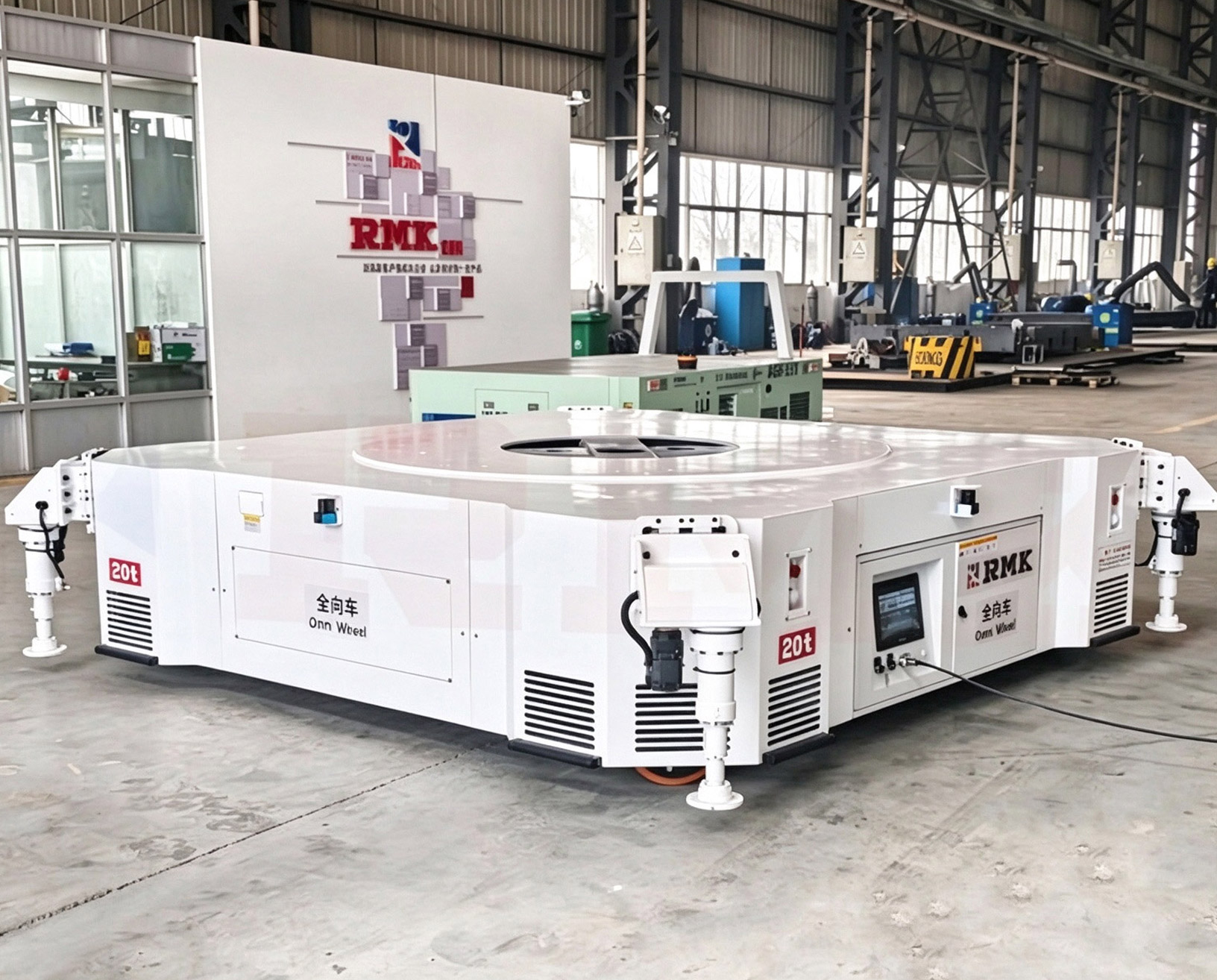
20-Ton Omnidirectional Transfer Cart with Longitudinal and Lateral Movement and Telescopic Arms
90-Ton Heavy-Duty Explosion-Proof Self-Propelled AGV
Frequently Asked Questions About Rail-Guided and Trackless Transfer Carts
Which Is More Cost-Effective: a Rail-Guided or a Trackless Transfer Cart?
-
There is no single answer that applies to every factory.
Rail-guided solutions require investment in track and foundation installation, but they provide a defined travel path for transportation along fixed routes.
Trackless solutions eliminate the need for permanently installed tracks, but they require suitable floor load-bearing capacity, surface conditions, and turning space.
A meaningful cost comparison should include equipment purchase costs, site preparation, energy consumption, maintenance expenses, and expected service life.
Can a Rail-Guided Solution Be Used If the Existing Factory Floor Does Not Allow Track Trenches to Be Cut?
-
Yes. The site can be assessed to determine whether an alternative track installation method is feasible.
Not all tracks need to be installed flush with the floor. In some projects, surface-mounted track installation may be a suitable option.
However, the floor structure's load-bearing capacity, track fastening requirements, vehicle clearance, and operational safety after installation must all be verified.
If the site is unsuitable for track installation, a trackless transfer cart can also be considered, provided that the floor meets the vehicle's operating requirements.
What If the Transportation Route Includes Ramps or Indoor-to-Outdoor Transitions?
-
Gradients affect the vehicle's traction capability, braking performance, and operating conditions under load.
Floor transitions may also affect wheel selection, ground clearance, and the vehicle's ability to pass over changes in floor level.
Whether selecting a rail-guided or trackless transfer cart, the following site information should be confirmed before equipment design:
Ramp gradient and angle;
Ramp length;
Floor surface material and condition;
Floor level differences and transition geometry;
Vehicle operation under full-load conditions, including starting, stopping, and braking on slopes.
It is advisable to provide detailed site information when submitting an inquiry so that the engineering team can evaluate the operating conditions and determine a suitable vehicle configuration.
How Can Pedestrians and Transfer Carts Safely Share the Same Workshop?
-
Both rail-guided and trackless transfer carts require appropriate on-site traffic management and safety measures.
Common measures include:
Clearly separating pedestrian walkways from vehicle operating areas wherever possible;
Installing suitable audible and visual warning devices;
Providing accessible emergency stop devices;
Assessing intersections, blind spots, and potential collision points;
Configuring appropriate protective devices and personnel detection systems according to the vehicle's operating mode and risk assessment.
For driverless industrial trucks and their systems, ISO 3691-4:2023 can be used as a relevant safety reference where the equipment falls within its scope.
However, this standard does not apply to trucks that are solely guided by mechanical means, such as fixed rails, or to trucks that are solely remotely controlled by an operator.
For other manually operated or remotely controlled transfer carts, safety requirements should be determined through an assessment of the actual vehicle design, operating method, and site-specific risks. The machinery risk assessment and risk reduction principles in ISO 12100:2010 can also be used as a general reference.
Can the Same Factory Use Both Rail-Guided and Trackless Transfer Carts?
-
Yes.
For large factories with multiple production areas and different transportation requirements, using both rail-guided and trackless transfer carts can be a practical solution.
For example:
Rail-guided transfer carts can be considered for long-distance transportation along fixed routes within the plant.
Trackless transfer carts can be used for flexible transportation in cold rolling workshops or between multiple workstations.
RGV systems can be considered for automated transportation along fixed track routes, while AGV systems can be evaluated for automated material handling where flexible navigation or route changes are required.
The key is to configure the equipment according to the transportation characteristics and operating requirements of each area, rather than expecting a single solution to handle every material handling task.
Conclusion
Choose Based on Operating Conditions, Not Equipment Preference
Both rail-guided and trackless transfer carts are effective industrial material handling solutions, but they are designed to meet different transportation requirements.
When transportation routes are fixed and repetitive, and the site is suitable for permanent track installation, a rail-guided transfer cart may be the preferred choice.
When a factory requires greater route flexibility and its floor conditions meet the vehicle's operating requirements, a trackless transfer cart may be more suitable.
For large industrial facilities, these two solutions are not necessarily mutually exclusive. Rail-guided and trackless transfer carts can be used together to create a more flexible material handling system tailored to the transportation requirements of different production areas.
Before making a decision, comprehensively evaluate the load requirements, transportation routes, floor conditions, operating frequency, power supply options, and safety requirements.
Need Help Choosing Between a Rail-Guided and a Trackless Transfer Cart?
Send us your load specifications, factory layout, transportation distances, and operating requirements.
The REMARKABLE engineering team can assess your application conditions and recommend a customized industrial material handling solution based on your specific needs.
References
AGV and AMR Industry Innovations: 2023 Innovations in the AGV and AMR Industry: A Review of New Products and Technologies
Driverless Industrial Truck Safety: ISO 3691-4:2023 – Safety Requirements and Verification for Driverless Industrial Trucks and Their Systems
Machinery Risk Assessment: ISO 12100:2010 – General Principles for Machinery Risk Assessment and Risk Reduction
Note: The equipment specifications and project examples presented in this article are based on available public information and are provided for reference during equipment selection. Actual project configurations are subject to project-specific engineering evaluation.